
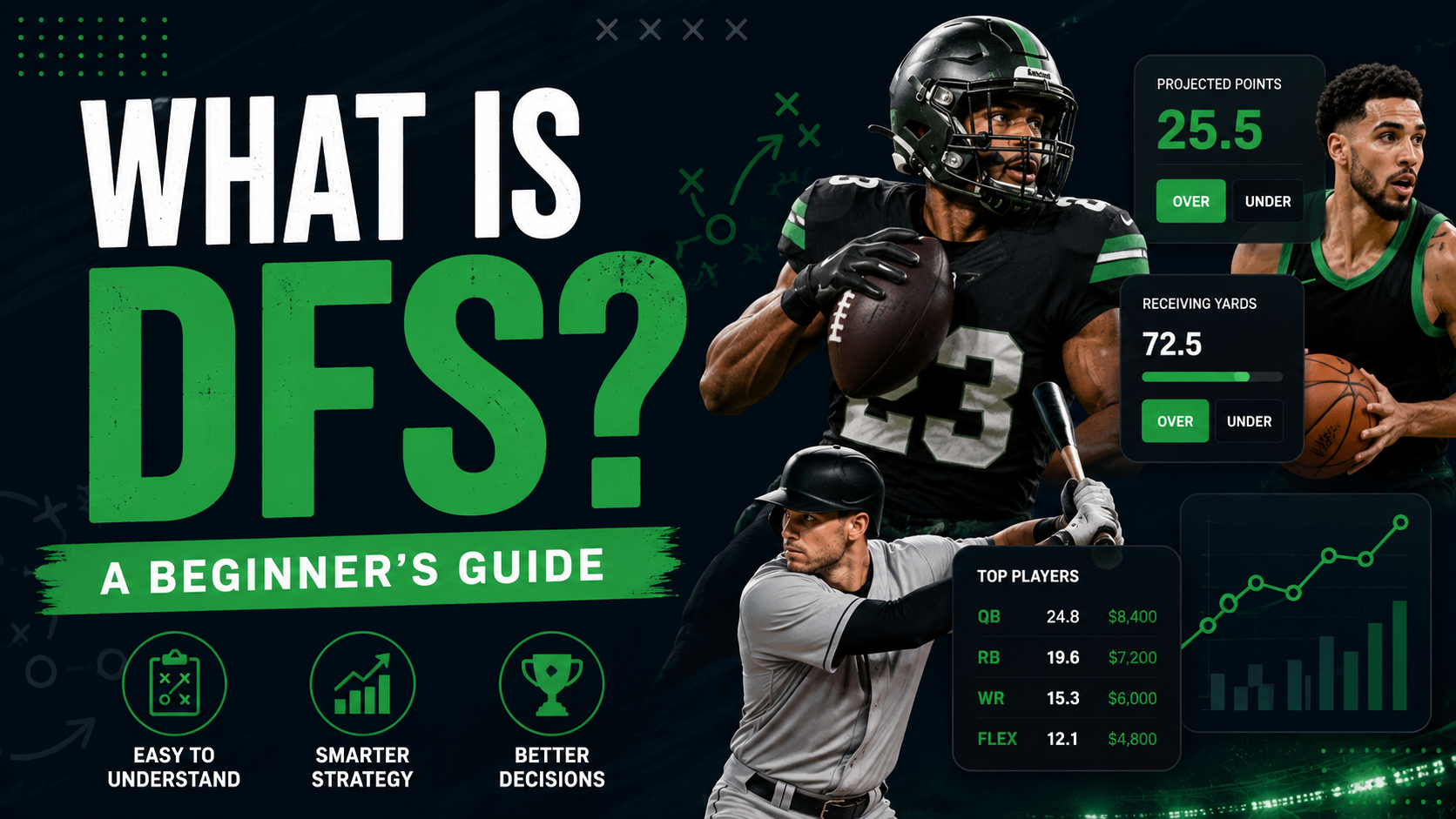
Daily fantasy sports, commonly called DFS, gives sports fans a way to make predictions about individual player performances and compete based on what happens in real games.
Unlike traditional season-long fantasy sports, DFS contests are generally settled over a much shorter period. Depending on the format, that could mean a single game, one day, or a group of games.
If you’re completely new to DFS, this guide covers the basics, common contest formats, important terminology, and what you should understand before playing.
What Does DFS Mean?
DFS stands for daily fantasy sports.
Traditional fantasy leagues may run for an entire season. You draft players, manage your roster, make trades, and compete against other fantasy managers over several months.
DFS speeds up that process.
You make selections for a particular slate of games, and the results are determined by how those players actually perform.
Once the contest or slate is complete, it’s over. You can then start fresh with another contest.
How Does Daily Fantasy Sports Work?
The exact rules depend on the DFS platform and contest type, but most formats revolve around predicting player performance.
For example, you might be evaluating whether a quarterback will throw for more or less than a certain number of yards or whether a basketball player will record a certain number of points, rebounds, or assists.
Other DFS formats have you construct an entire fantasy lineup while staying under a salary cap.
Your selections earn fantasy points or are evaluated against predetermined statistical projections depending on the format you’re playing.
Pick’em vs. Salary-Cap DFS
Two of the most common styles you’ll encounter are pick’em contests and salary-cap contests.
Pick’em DFS
Pick’em games generally ask you to predict whether players will finish above or below particular statistical projections.
For example, you might see:
Player A — 24.5 Points
You then select whether you think the player’s final total will be higher or lower than that projection.
Platforms such as PrizePicks and Underdog Fantasy offer variations of this style of fantasy contest.
Salary-Cap DFS
Salary-cap DFS works differently.
Players are assigned fictional salaries, and you’re given a maximum budget for building your lineup.
The challenge is finding the best combination of players without exceeding that salary cap.
Instead of simply choosing the biggest stars, you have to balance expensive players with lower-cost selections that you believe can outperform expectations.
What Is a DFS Slate?
A slate is simply the group of games included in a particular DFS contest.
For example, an NFL Sunday afternoon slate might contain several games being played during that time window.
Your available players and selections would come from those games.
Slates can vary considerably in size. Some contests cover many games, while others focus on just one matchup.
Common DFS Terms Beginners Should Know
You’ll encounter plenty of terminology when you start learning DFS. Here are some of the basics:
Projection: An estimate or statistical line representing an expected player performance.
Entry: The lineup or group of selections you submit to a contest.
Slate: The group of sporting events included in a contest.
Flex Play: A contest structure where an entry may still qualify for a payout even if every selection isn’t correct. Rules vary by platform.
Correlation: When the performances of two or more selections may be related.
Bankroll: The amount of money you’ve designated for playing DFS.
Variance: The natural unpredictability that causes actual results to differ from expected results.
Understanding these concepts makes DFS considerably easier to follow.
Is DFS the Same as Sports Betting?
Not exactly.
DFS and traditional sports betting can involve similar analytical skills, such as evaluating statistics, injuries, matchups, and expected performance. However, they’re structured differently and may be treated differently under applicable laws and regulations.
DFS rules and availability also vary depending on your location and the platform you’re using.
Always check the rules and eligibility requirements of a platform before participating.
Can You Guarantee Winning at DFS?
No.
Even a well-researched selection can lose.
Players get injured. Games become blowouts. Coaches change rotations. Weather changes. A normally reliable player can simply have a bad game.
Good DFS strategy is therefore less about trying to find a “guaranteed winner” and more about making informed decisions while understanding that uncertainty is always involved.
Tips for New DFS Players
If you’re just getting started, keep a few principles in mind:
- Learn the rules before entering a contest. Different platforms and contest types can work differently.
- Start small. There’s no reason to risk significant money while you’re still learning.
- Research your selections. Consider recent performance, injuries, expected playing time, matchups, and other relevant information.
- Don’t chase losses. Losing doesn’t mean your next entry is more likely to win.
- Set a budget. Decide beforehand how much you’re comfortable spending and stick to it.
- Keep records. Tracking your entries can help you identify where your decision-making is strong or weak.
The Bottom Line
Daily fantasy sports takes many of the concepts people enjoy about traditional fantasy sports and compresses them into shorter contests.
There are several different ways to play, from building complete salary-cap lineups to making player-performance selections on pick’em platforms.
For beginners, the best place to start is simply understanding the rules and terminology. Once you understand how contests work, you can begin learning more advanced concepts such as projections, correlation, contest selection, and bankroll management.
HowToDFS is here to help you do exactly that.